
December Ponderings

Sometimes I run across articles that make me think about how they relate to my own idea of how to run a financial planning practice. I think about the specific points made, consider how these points apply to me, and then respond appropriately. They make me think and sometimes my thoughts force me to address changes that I might need to consider making or possibly they re-confirm decisions that I have already made. Either way, it’s a win-win, and I become a better advisor.

Alan Roth is a financial advisor from Colorado Springs (Wealth Logic). He has developed a reputation for thinking-outside-the-box and isn’t afraid to ask tough questions or ruffle feathers. His advisory practice is set up to create a financial plan with a fairly simple investment allocation and supply a set of straightforward instructions for the client to follow going forward. It’s a one-and-done deal, and he quips that once completed, the client is encouraged to “fire” him. He charges a premium for this but it is usually quite a bargain compared to being charged a fee based on assets year after year.

Mr. Roth is an accomplished writer as well and publishes articles regularly. Most are succinct reads that often provide a fresh or alternative perspective on old subjects. A recent article of his outlines the ten things he does to differentiate his practice from an otherwise increasingly commoditized profession. Roth champions the hourly fee arrangement as opposed to the popular percentage of Assets-Under-Management (AUM) and states that simple portfolios are typically a better fit for a complex world, especially when it comes to taxes and other more complicated considerations. There are plenty of nuggets here that I find thought-provoking.

For instance, he maintains an anti-sales approach and insists that after a free 20-minute consultation, the client should sleep on it before committing to an engagement no matter how eager they might happen to be at that moment to sign up. His streamlined client acquisition approach is also appealing. He requires each client to fill out an online questionnaire before the 20-minute consult in order to gain a good idea of the client’s current situation and their reason for reaching out. This helps him weed out people who are really not a good fit for his approach and probably won’t really buy-in. All the same, those who fill out that questionnaire still get the free 20-minute consult and his advice on how best to move forward.

Let’s face it. There are probably too many advisors out there earning that typical 1% AUM fee year over year who probably are not really earning it on an annual basis, especially after the client is set up initially. However, my particular belief is that most financial plans are truly a work-in-progress that do need to be monitored on a timely basis and that a good advisor can also serve as a “coach” keeping the client motivated and disciplined over time, especially during periods of market turbulence. I’m comfortable in my vision of keeping fees relatively low but ongoing. However, I do believe in allowing the client to choose another approach (the one and done) if that makes them more comfortable.


Another recent article that caught my attention was written by Dorothy Hinchcliff and published in in the November 2018 issue of FA Magazine. It discusses how advisors can really help those nearing or in retirement by addressing ten important issues.

The 10 issues to discuss are:

1. When and how will a client retire?
2. When should the client start Social Security?
3. How can the client use savings to build a retirement income portfolio?
4. What Medicare choice should the client make?
5. Does the client need to reduce living expenses, and how?
6. Should the client deploy home equity to generate income?
7. How can the client protect against long-term-care expenses?
8. How can clients protect themselves against financial fraud?
9. How can a spouse be protected when the client is gone?
10. Does the client want to plan for a financial legacy?

The articles suggests creating three separate sources for satisfying retirement financial needs:

• Retirement paychecks. These are guaranteed to last the rest of your life, no matter how long you live, and they don’t go down in stock market crashes. Use these to cover your basic living expenses, food, a roof over your head, medical premiums, utilities. Retirement paychecks can come from Social Security, a traditional monthly pension, a low-cost annuity or a reverse mortgage.

• Retirement bonuses. These typically come from invested assets or salaries from working. Use these to cover your discretionary living expenses, like travel, hobbies and gifts for grandchildren. Retirement bonuses can come from systematic withdrawal plans, including the IRS’s required minimum distributions from retirement accounts; interest and dividends from savings; working or self employment; and rental real estate.

• Cash stash. This money covers emergencies so you don’t have to dip into your savings.

A quote from the article: “The secret is paying attention to motivation and inspiration. The strategies are straightforward to understand, but they’ll take discipline and hard work to implement. And that’s where advisors play a key role. To help inspire, and motivate and persist, and to encourage your clients.”

The above ten questions and their respective answers in one way or another form the basis of a strong retirement plan.
 

Posted in Retirement Planning | Tagged , , | Leave a comment

Let’s Get Real About Capital Market Assumptions

There are many independent variables that go into the creation of a financial plan.

Some are more within your control:

  • your discretionary spending
  • the percentage of your salary invested

While some others aren’t:

  • the rate of return on your investments
  • your longevity

The focus of this article is determining a realistic rate of return on investments going forward into the future from this point in time. This means looking at each separate asset class that comprises that return and applying a separate return to each one, then determining the overall rate of return given the prescribed asset allocation (example: 60% Equity/40% Bonds).

Many financial plans are based on historical returns and that can be a dangerous proposition. Although the past provides a good idea of what may be reasonable going forward, there is certainly no guarantee that it will be repeated, especially in the short-term.

Given that as of this time (October 2018) the market has been on an extended bull run since the Financial Crisis of 2008-2009, it is especially perilous to project forward using historical returns. Stocks have delivered real returns averaging close to 14% per year for the past nine years, so it may be difficult to imagine a future scenario where returns drop down to the 3% to 5% range. However, stocks can only deliver what comes from dividends and dividend growth plus increases on PE ratios, and, with PEs at elevated levels, the direction is more likely down than up. Bond returns for intermediate and long maturities are largely locked in at current yield levels.

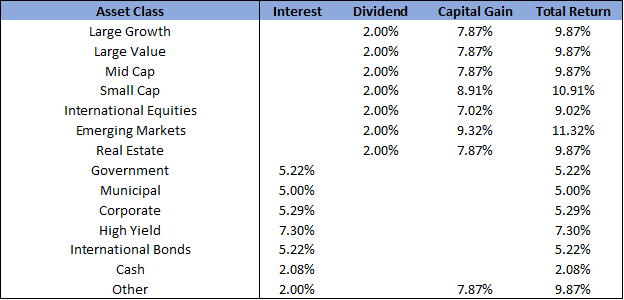
The below table reflects the actual returns earned by each asset class over the last fifty years:

Historical Returns

Given the robust returns experienced over the last decade since the Financial Crisis, most experts believe that with current market PEs remaining relatively high, below average returns should be anticipated moving forward over the next decade.

As of October of 2018, many experts believe a realistic long-term rate of return for the stock market (as represented by the S&P 500) currently resides around 7%-8%. With inflation expected to run at 2.5%, the projected real rate of return falls to 4.5%-5.5% (the real return is the earned rate of return minus that year’s inflation).

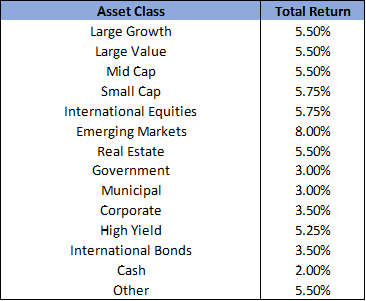
Financial Planning software company Right Capital currently proposes the below as conservative yet realistic assumptions moving forward. They use JP Morgan’s current research as the basis for these asset class projections.

Projected Returns

As a previous blog post mentioned, the most damaging thing that can happen to a financial plan might well be underestimating the effect of a rise in inflation, as the real rate of return can get squeezed from both ends (less return – more inflation = squeezed real return).

If a planner is using yesterday’s average returns for a client’s current plan, he should also run the same numbers with lower projected returns to see the magnitude of the difference it makes. With interest rates probably moving higher along with inflation, it is the real return which matters. Financial plans using historical returns that presently have an 80% Monte Carlo success rate would probably dip below 50% at such reduced returns. I recently saw a plan where the success rate falls from 89% to 39%!

When you think about it, the most likely scenario is not really investment returns decreasing to the above projected percentages on a long-term basis, but rather a 1-2 year period of steep negative returns as experienced in 2008-2009. A worst-case scenario might be something like -35% return in year 1 followed by -10% in year 2, and then a return to the more buoyant historical numbers, but perhaps with even those tweaked down a bit.

That’s why perhaps its better to adjust those numbers down more modestly for now, and then run different “bad case scenarios” to show that potential of a poor 1-2 year period, and then remind the client that as time goes by without any such sell-off occurring, the likelihood of such an event increases even more.

Right now is a good time to make sure that portfolios are in balance with targeted allocations and that the amount of risk associated with that portfolio is acceptable given a client’s desired return, risk tolerance, risk capacity, and especially, the length of time until anticipated retirement.

In other words, it’s time to get real about future returns.


Posted in General | Leave a comment

Easing the Retirement Crisis: A Quick Summary & Example

Morningstar recently released a study conducted by Steve Wendel regarding the state of retirement in the USA and the various separate levers which can be tweaked to improve prevailing deficiencies (Easing the Retirement Crisis). Some of Wendel’s key observations are as follows:

  • In a recent survey, only 17% of American workers felt very confident in their ability to retire comfortably (EBRI 2018).
  • Even when extreme actions are taken, saving more, choosing to invest one’s savings, delaying retirement, and lowering one’s expectation of living have a far greater effect than asset allocation, reducing fees, or achieving alpha.
  • For each individual action, extreme changes—like a 20% increase in contributions—are needed to move the bulk of households into a comfortable financial place. However, such austerity isn’t necessary. Instead, combining multiple, less-extreme changes can be quite effective. For example, if Americans delayed retirement until at least age 67 and contributed at least 6% in the meantime, that would boost the percent of American households having what they need from 25.6% to 71.2%.
  • Each household, however, has its own demographic and financial situation. Delaying retirement can be very impactful for one individual, but not particularly effective for another.
  • Broad financial planning is essential, and multiple tools can help Americans succeed. Multiple levers are available to improve this outlook. We analyzed eight different options, and found that delaying retirement, contributing more, and lowering one’s expectations for retirement, can be tremendously effective at improving retirement readiness.
  • Individually, even these levers require extreme actions to move the needle—like a 10-year delay in retirement. Together, they are far more powerful, and do not call for extreme actions.
  • The right answer isn’t a new default: it’s a personalized analysis of what each household needs. Americans pay the price for not having advice tailored for their needs.

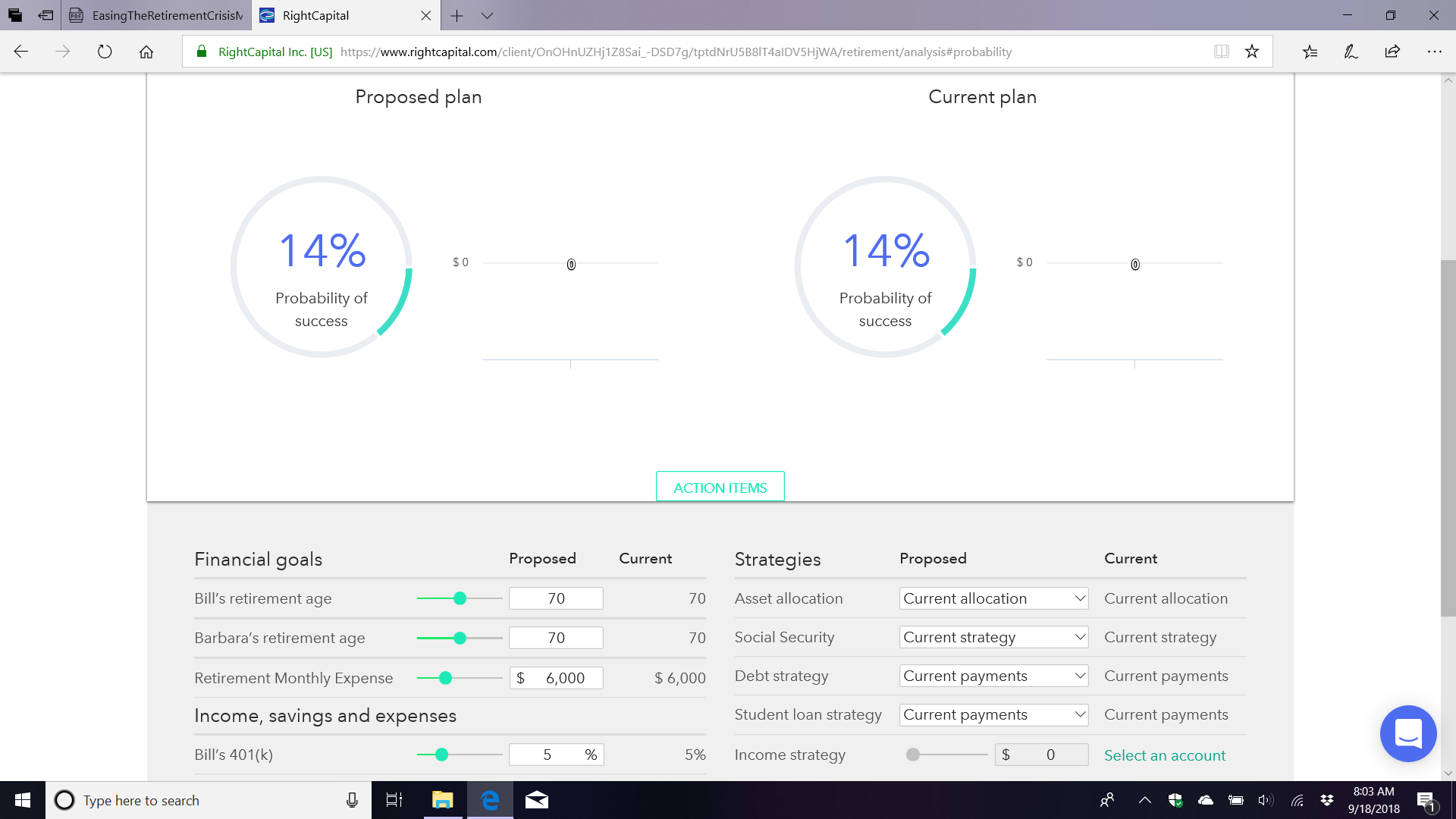
I decided to construct and example in Right Capital and create a baseline Current Plan and then tweak various levers to create a Proposed Plan. The example is of a couple with only the husband working, both aged 48. Presently he is earning $110,000 a year with expected increases of 3% per year until retirement. To keep it simple, the only goal considered is retirement spending along with retirement health care costs (a default goal which is provided by Right Capital).

Image 1 reflects the baseline Current Plan (no changes to Proposed Plan). Please note only a 14% probability of success.

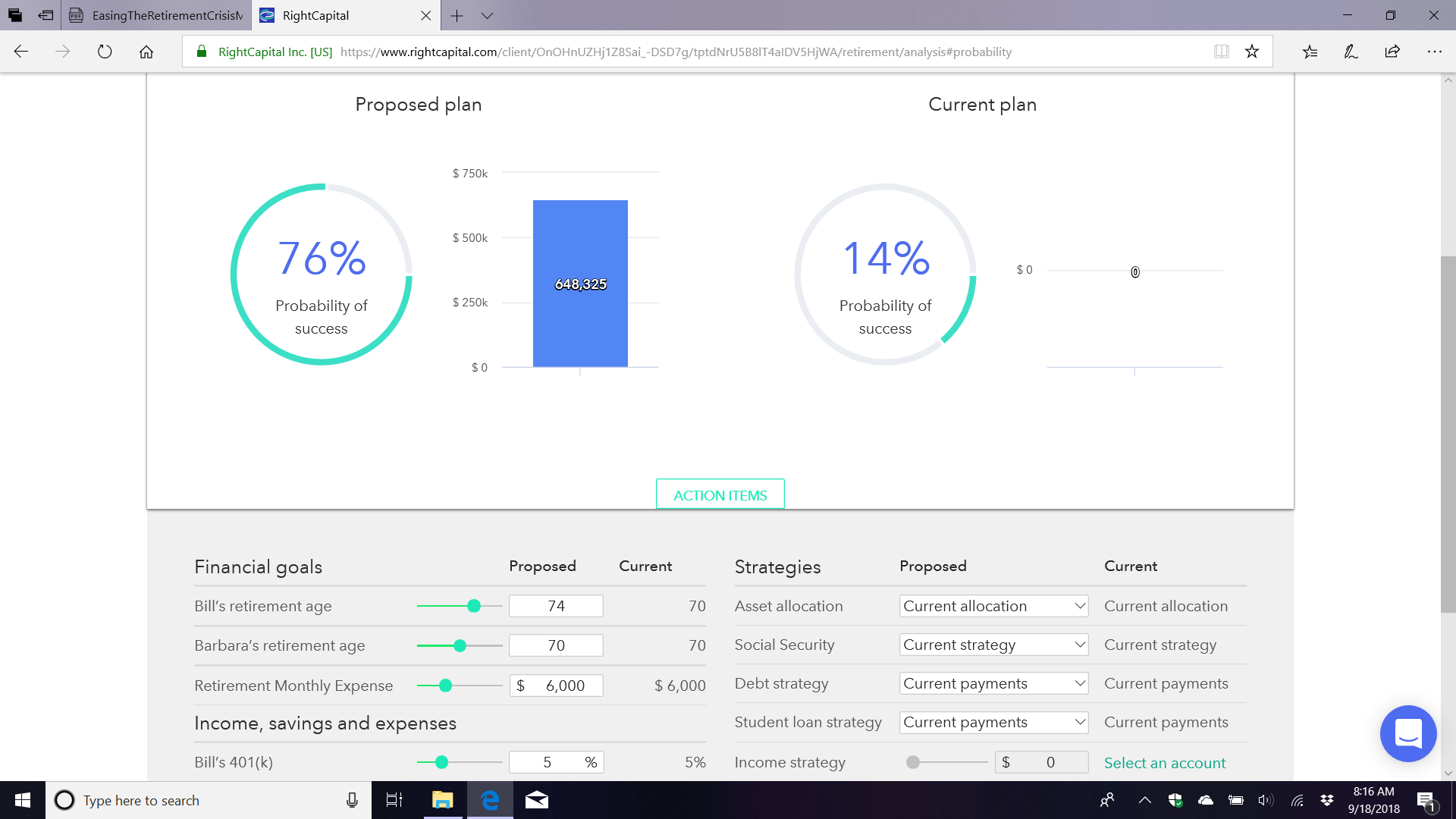
Image 2 reflects an increase in the age of retirement of four years, from age 70 to age 74. The probability of success responds significantly to this change, popping up to 76% In fact, this one change, in this example, could be sufficient on its own. As the article states, each individual situation can vary, and the effect of altering any lever can be different for each case depending on how all the variables work together. In this particular example, it can readily be seen that working four years longer truly has an out-sized effect, primarily due to the fact that the highest salaries are being earned and excess cash flows saved while those four years likewise reduce the amount spent during retirement.

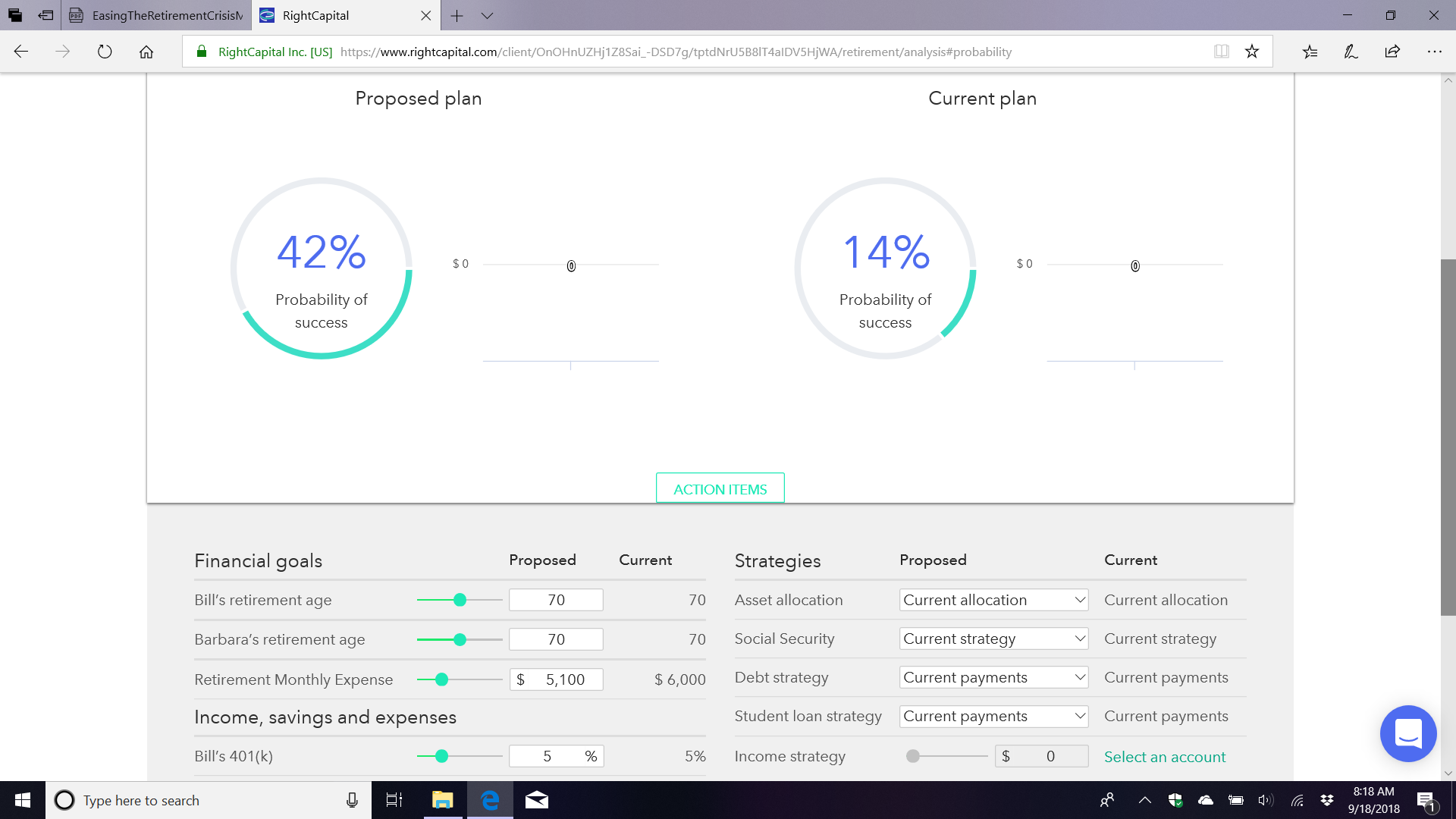
After resetting retirement age back to 70, Image 3 demonstrates the effect of cutting retirement expenses by 15% a year ($6,000 per month down to $5,100). The result here is not as dramatic, as the probability of success only increases to 42%.

Image 3

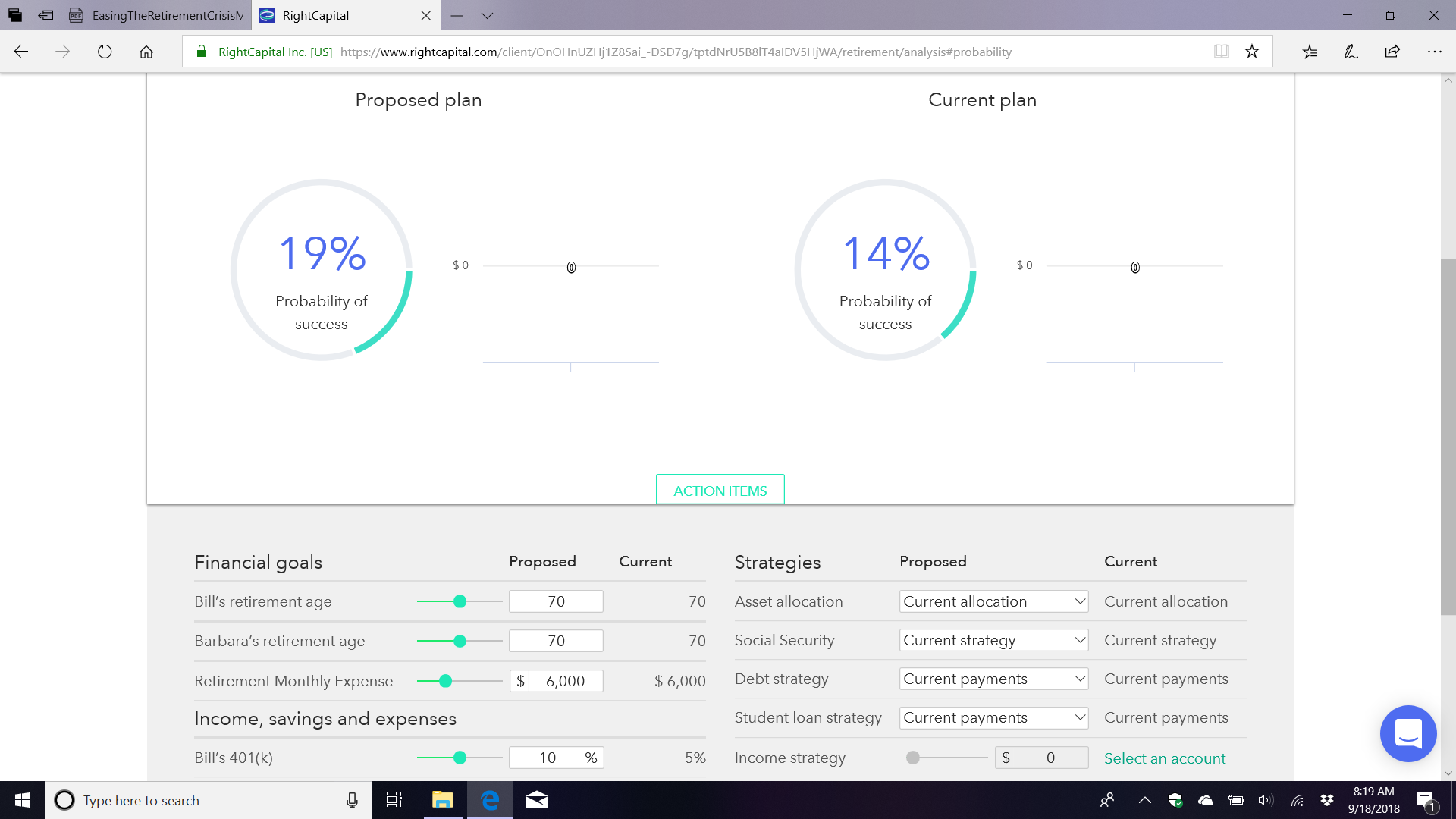
Increasing the client’s contribution rate from 5% to 10% has even less effect, bumping up to 19% (Image 4).

Image 4

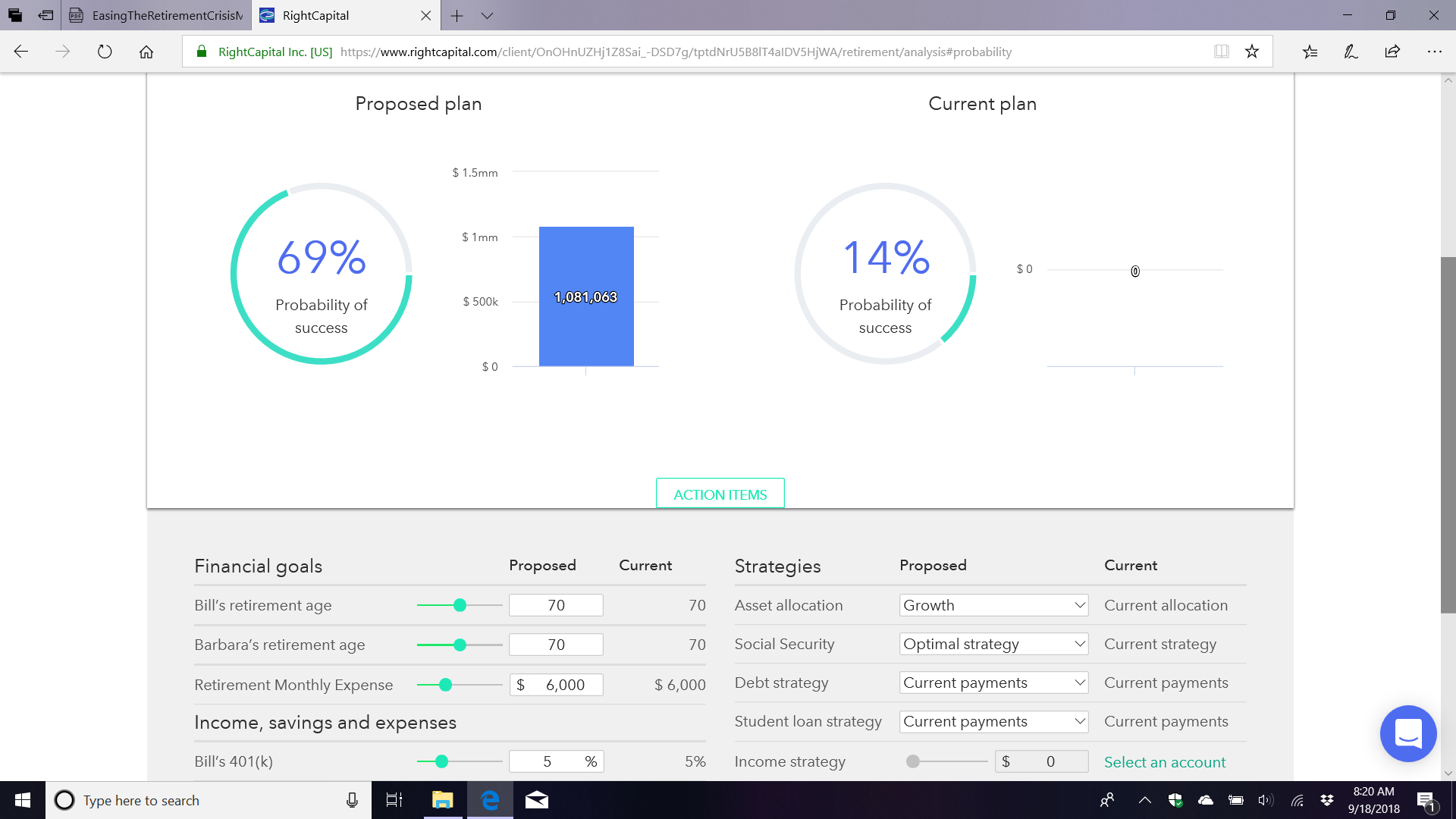
Now we reset all back to the baseline, and take a look at only installing a proper asset allocation to the client’s previously conservative portfolio. A growth allocation has a significant impact, raising the probability of success to 69% (Image 5).

Image 5

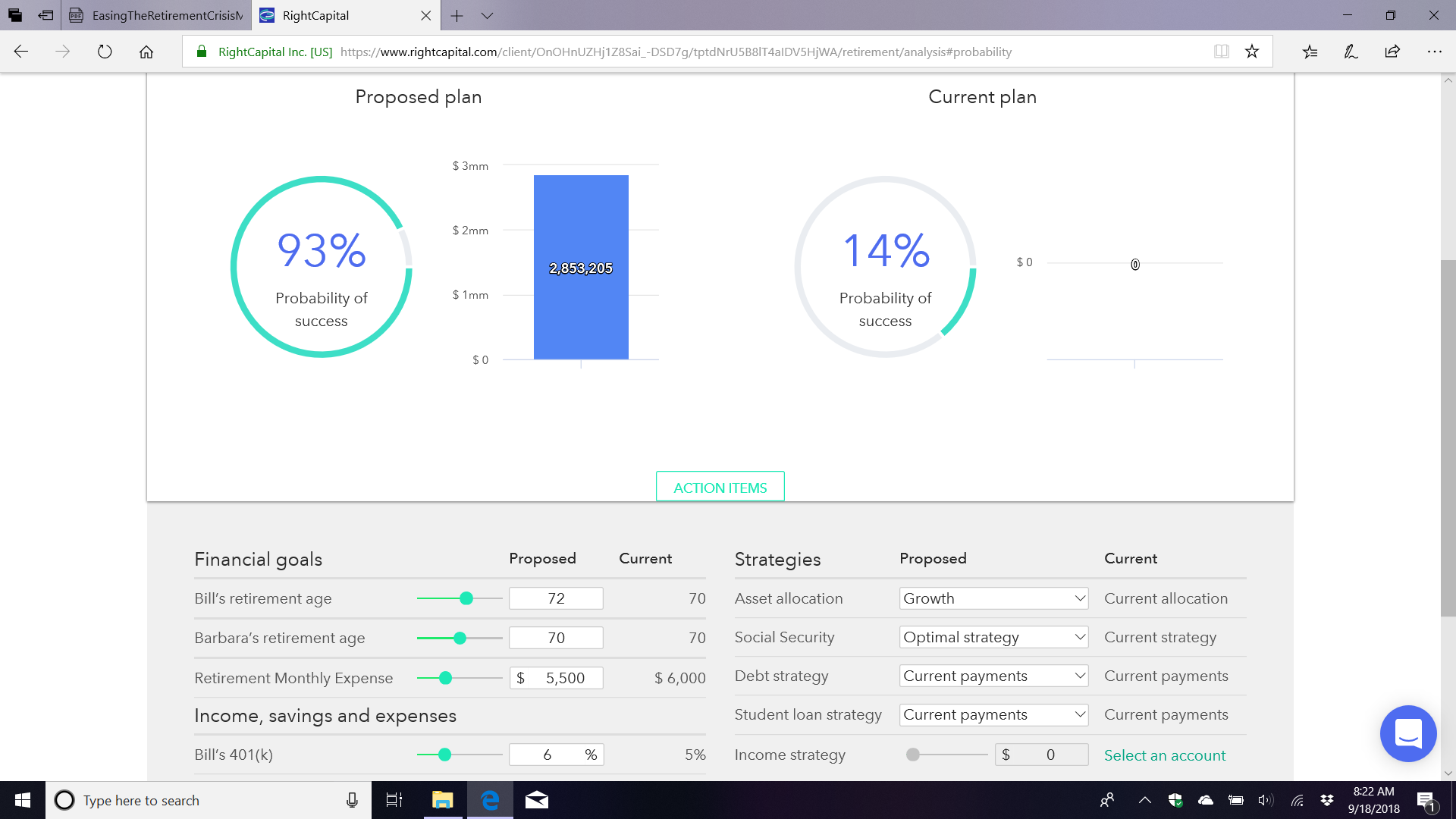
Image 6 reflects the result if four levers are tweaked more modestly. Instead of retirement at 74 the client retires at 72, retirement spending is reduced by 8.3% instead of 15%, the savings rate is only increased from 5% to 6%, and the growth allocation in the portfolio is maintained (at least until the client approaches retirement; along the way the equity exposure might be dialed back, especially if above normal returns have already been achieved). The result is a robust 93% probability of success and in the process the changes are more doable.

Image 6


The above reflects why different scenarios should be considered when reviewing a client’s retirement plan. Improving one lever, such as the delaying of retirement, can have a large impact. But what if the client chooses not to accept such a delay? What if  that is the one option they cannot tolerate? It is then that the advisor should play with all available input variables to reach smaller compromises that the client can accept and actualize.

This is also why I view good planning as an ongoing process. From one year to the next these variables evolve as markets may prove more volatile, or perhaps an expected increase in salary is not received, or maybe that year’s contribution to the 401(k) is materially reduced due to other unexpected expenses.

As noted planner Harold Evensky has stated: Practitioners should not treat long term planning as an exact science with a focus on the accuracy of the second decimal place but rather as an educated art designed to provide reasonable guidelines in assisting clients plan their future. Furthermore, it is not a case of plan and forget but rather plan, monitor and modify as necessary.

Posted in General, Retirement Planning | Tagged , , , , | Leave a comment

Career Starters: Don’t Fret Your Investment Return, Just Save!

A quick reminder to career starters (those in their 20s to mid 30s):

During your early years of savings and accumulation for retirement, the percentage of salary allocated to such saving and those actual dollar contributions matter much more than the rate of return earned in the portfolio account.

As that sum grows, the rate of return does become increasingly more meaningful which eventually leads to sequence of return risk as retirement approaches. And of course, a high savings rate should be encouraged through all working years.

As a simple example, take the investor with a beginning salary of $100,000 who contributes 10% of salary per year. Further, assume his salary increases 10% a year over a ten-year period.

Assume two sequence of returns over the ten-year period, the same exact numbers except the first five years are reversed for each sequence. However, both average 5.6% per year over the decade:

Sequence One:   9%  12%   7%   5%   15%      -3%   4%   9%   -7%   5%   Avg = 5.6%

Sequence Two:  -3%  4%   9%   -7%   5%       9%   12%  7%    5%   15%   Avg = 5.6%

After five years, the Sequence One balance is $80,233 while Sequence Two lags well behind at only $64,163. But by year seven, Sequence Two has caught up with Sequence One and after ten years it tallies $230,423 while Sequence One now lags at $189,487. The out-performance due to sequence of return risk is $40,936 or +21.6%.

Both sequences average 5.6% over the ten-year period but clearly the superior performance over the last few years while sums are at their highest points has a dramatic effect.

One step after another, we’re on our way!

Points to be considered:

  • Returns are random and cannot be predicted
  • A better sequence of returns toward the end of the accumulation phase has a significant positive effect
  • Career starters can control their savings rate and should attempt to make it a healthy one

In the end, it’s the same mantra: Start saving early, be consistent with a healthy contribution rate, and rebalance on a timely basis.

Posted in General, Retirement Planning | Tagged , , | Leave a comment

How to Deal with Retirement Blind Spots

Morningstar’s Christine Benz recently wrote a great piece regarding the five retirement blind spots which can derail a successful retirement. Below is a list of each blind spot and I have responded with my ideas as what to do to perhaps shed a little more light and vision to these potential problems.

1. Market Risk – The issue at hand here is the bad luck of experiencing a large loss at retirement when your portfolio balance is typically at its highest level. As an example, you have worked hard for years to get that portfolio balance up and over $1 million, and then look out, here comes an 18% market sell-off (which leaves $820,000 in your account not counting the sum withdrawn for living expenses and any taxes for that year) followed up by another 11% loss the next year (now leaving only a balance of $729,800). Whereas you had at the beginning of your retirement an average of $33,333 in the account for an anticipated 30-year retirement, you now only have $26,064 for the remaining 28.

There are various ways to mitigate this risk.

One way is to ease into a cash bucket as retirement approaches with an amount of liquid funds covering 2-3 years of expected distributions. While you may miss out on maximizing returns as you liquidate the appropriate portion of equities, this approach does give you the peace of mind to know that you are now liquid enough to wait out the bottoming process if a sell-off does happen to occur.

Another approach is to just reduce the risk of your portfolio as you approach retirement without any regard to specific cash flow needs, and then ramp back up with more risk as you proceed along the retirement glide path (see Michael Kitces – Should Equity Exposure Decrease In Retirement, Or Is A Rising Equity Glidepath Actually Better?).

And, when all else fails, the one thing you can always control is your amount of discretionary spending. Not particularly the best way to start off a retirement perhaps, but in doing so you are taking a major step in ensuring that adequate balances remain down the road when returns normalize and are maybe even larger as they revert back to the norm.

Additionally, Benz offers her thoughts on what to do at retirement if the market heads south (What If This Turns Out to Be a Terrible Time to Retire?).

2. Inflation – Higher than expected inflation is actually one of the greatest threats to retirement fund adequacy. This might come as a surprise to many. The reason for this is that the constant bite into real returns year after year takes its toll. Since this is an unavoidable threat, the best way for investors to address it might be to place a certain amount of retirement funds into commodities and real estate which historically have tended to correlate better with inflation. Dr. Craig Israelsen’s 7Twelve Portfolio allocates 25% of funds into commodities, natural resources, and real estate in its base model. Although it may under-perform short-term when equities are on a tear (as it has recently), it does have an impressive long-term history through many market cycles.

Purchasing TIPS as a part of your bond allocation can also help.

3. Taxes – Tax rates are relatively low right now and there is certainly a risk that they may move higher somewhere down the road. Maybe sooner than later. The client should remain alert and flexible when it comes to taxation. It’s always a good idea to be tax-diversified (meaning that you own assets in taxable, tax-deferred and tax-free accounts). This allows for more distribution flexibility if needed. The client should consider converting tax-deferred assets like 401-Ks to tax-free ROTH IRAs during a low-tax period when income is decreased, typically between retirement and the age when they begin taking Required Minimum Distributions (as late as 70 1/2), which can save significant sums over a long retirement period as those accumulated conversions (taxed at lower rates) are allowed to compound tax-free.

4. Healthcare / Long-Term Care Expenses – These days, most financial plans build in a separate retirement goal for out-of-pocket health care costs, which can be significant. Pursuing an active and healthy lifestyle and considering Long-Term-Care (LTC) insurance are the obvious responses to this retirement blind spot. There seems to be a general reluctance to spend funds on LTC premiums but the client should at the very least be shown illustrations reflecting the impact of such potential expenses on their portfolio should they occur. And in an effort to be entirely transparent and thorough, the client should acknowledge that they were advised regarding the pros and cons of LTC insurance, and include a signature if so declined.

Hybrid policies combining LTC with Life Insurance are becoming more popular these days and may prove to be more palpable for clients despite being somewhat more expensive.

There have been recent articles stating that perhaps some retirement health care expenses have actually been overstated. In the end it’s better to be more safe than sorry, but as time moves ahead, medical costs will certainly be a trend to keep a watchful eye on.

5. Unanticipated Expenses – The best way to deal with unexpected expenses is to expect them! Create a buffer zone, remain flexible, and keep a positive attitude. Easier said than done.

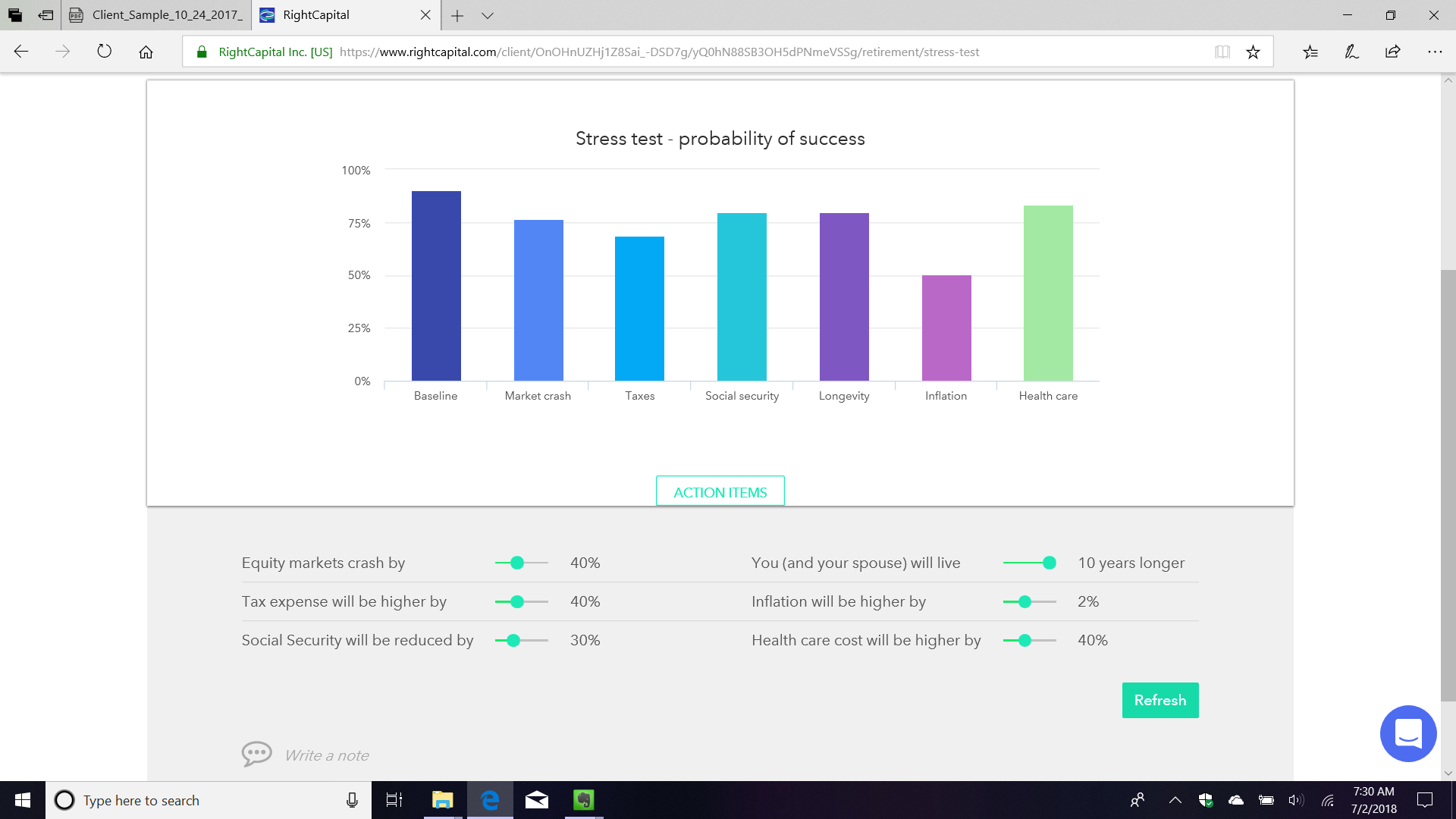
The above chart reflects the impact of the specific retirement blind spots as numerically listed:

  • Baseline – 90.2%
  • Market Crash of 40% (12 years before retirement date) – 76.9%
  • Taxes increased by 40% – 68.4%
  • Social Security reduced by 30% (often cited percentage if nothing is done to bail out the system) – 79.6%
  • Longevity increased by 10 years – 80%
  • Inflation increased by 2% (really hurts in a low-return environment) – 50.1%
    Health Care increased by 40% – 83.6%

The baseline current plan in this one example has a 90.2% chance of being successful (using Monte Carlo simulations) under expected conditions.

These results reflect the idea that most bad events can be overcome by sticking to the plan. Again, in this particular case, it is inflation that provides the greatest risk.

Posted in General, Retirement Planning | Tagged , , , | Leave a comment

The Value of Using a Financial Advisor: Reducing Debt as a Form of Fixed Income Investing

Financial writer Jonathan Clements once noted that if you do not have a consistent source of current income during retirement, then it makes little sense to have outstanding debt such as a mortgage which requires a monthly payment. A desirable goal for all retirees is therefore to be debt-free.

Additionally, financial advisor Alan Roth has written quite a bit about the idea of retiring debt instead of adding to fixed income investments, due to the fact that what the client is paying out in interest is probably quite a bit higher than whatever interest the client is earning on bonds. Paying off a loan has a known return, that being whatever interest rate the client is presently paying out. In May of 2017 I wrote a blog regarding this very matter: Cash Earning Next to Nothing? Here’s an idea… Retire Debt!

A penny saved is indeed a penny earned.

Taking these two ideas together, for the client who is approaching retirement, it makes sense to review their current debt situation, especially any residential mortgage balance. When do they plan to retire and will the mortgage be paid off by that time? If not before or at retirement, then how much longer will it need to be serviced before paid in full?

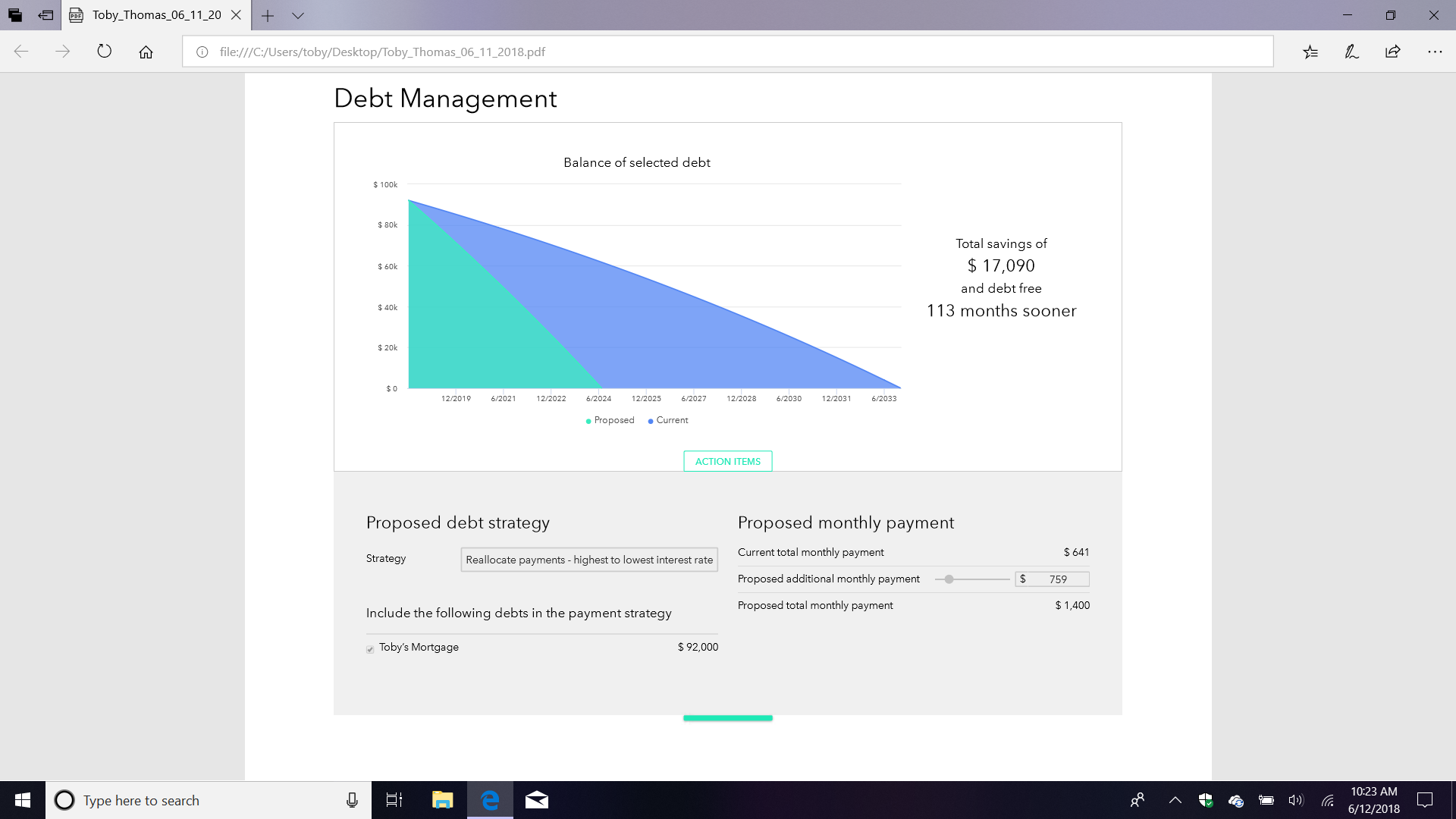
As an example consider the following 58-year old client. He presently has a variable rate loan on a $92,000 mortgage balance. Plenty of equity exists as the property is valued around $320,000. The variable rate, adjusted annually and almost assuredly trending upwards, is currently set at 3.5%. The current payment is only $641 and the client can afford to pay more, especially if such money is considered as part of his scheduled fixed income savings. Playing around with the numbers, it is determined that by paying $759 more per month ($1400 total) the loan would be completely paid off by the middle of 2024, some 113 months earlier than currently scheduled, while saving $17,090 in interest payments (and, as mentioned, these interest costs could easily trend higher).

By retirement the client’s property would be owned free and clear and the only home expenses remaining will be general upkeep, home insurance, and property taxes. As a bonus, if additional retirement cash flow is ever needed, the client could be eligible for a reverse mortgage somewhere down the road.

Obviously, for many homeowners, paying that much more a month could certainly prove to be an onerous burden, even after considering the cash additions as a part of regular savings. But whatever they can afford to pay they probably should consider doing so, while also taking into consideration the residual effect on their total prescribed asset allocation. For most investors, over the past few years the equity portion of that allocation has already increased as a percentage of total assets anyway, and so directing more new cash to fixed income is warranted.

Many advisors are reluctant to recommend such a practice as reducing debt removes potential assets from the client’s portfolio and correspondingly reduces their assets under management. This is another reason to consider using an advisor who charges by retainer or by hours and not by AUM. And yes, the tax deduction for interest will at some point be lost when the debt is terminated, but that deduction is certainly not worth the real cash savings as reflected above and is reduced by recent tax law changes anyway (ie – most taxpayers will be using the increased standard deduction in lieu of itemizing).

The mandate is clear: a goal for most clients is to be debt-free at retirement, and a good financial advisor can demonstrate the real benefit and then develop the most efficient path for getting there.

Posted in Debt Reduction, Retirement Planning | Tagged , , , | Leave a comment

Three of the First Things to Consider When Creating a Financial Plan

Three of the things to consider when creating a financial plan are (1) the Investment Policy Statement, (2) the client’s risk tolerance, and (3) the appropriate amount of cash to set aside for an emergency fund.

The last two items can actually be incorporated into the Investment Policy Statement (IPS), the one document which provides guidelines to follow when establishing all financial plan parameters given client resources and objectives. At the very least, the IPS should detail a client’s planning horizon in terms of years until specific goals are to be reached and their risk tolerance as determined usually by a questionnaire. The IPS can provide more detail by also disclosing the desired targeted rate of return and the appropriate asset allocation along with the specific asset components to be used, such as mutual funds, ETFs, bonds, individual stocks, etc. These can be further broken down into growth, value, large-cap, mid-cap, small-cap, international, bond type and quality, and other special assets such as real estate and commodities. The frequency of rebalancing should be addressed and the use of legacy positions noted (example: a large allocation to one particular investment, such as a large gift of IBM stock). In fact, anything that the advisor deems as useful in documenting the chosen strategy should be listed. If a client declines to be specific regarding any of these requested details, then that declination should be noted and dated.

A client may have a risk tolerance that differs from their risk capacity. Risk capacity reflects the amount of financial buffer a client maintains which affords them more flexibility in pursuing higher return with the associated higher risk. The ability to absorb a potential loss without affecting their ability to reach a stated financial goal equates into higher risk capacity. Those with low risk capacity, as a rule, should follow a plan that out of necessity includes a lower risk asset allocation. Likewise, there are risk averse affluent investors who are more comfortable following a low risk allocation despite their large financial buffer and risk capacity. In the end, it always comes down to the client’s temperament and ability to sleep at night.

The emergency fund should be the first designated portion of an investor’s portfolio. These funds should be kept in cash or highly-liquid money markets instruments offering the client three to six months of cash flow coverage should an unexpected event occur, such as a loss of a job or a major expense (think hurricane or sudden illness). Again, the length of time covered by these funds should be determined by the client’s general tolerance for risk and also perhaps the steadiness of their employment as well as other pertinent factors.

The Investment Policy Statement (IPS), Risk Tolerance, and the Emergency Fund form the foundation of a solid financial plan. It’s a good idea to create these three parts of a plan right away even if some details remain unclear at the time. They can always be added later and in some cases the parameters may be revisited and tweaked if deemed appropriate. Only after these three items have been duly considered should the rest of the plan be developed.

Posted in General | Leave a comment

Rebalancing Likely Boosts Returns While Reducing Risk

Alan Roth recently wrote an article regarding the benefits of rebalancing at ETF.COM.

Here are some of the highlights:

“By rebalancing to a target asset allocation, you have to buy stock funds after a plunge and sell after a surge.”

“The key purpose of rebalancing is to maintain the appropriate level of risk, but it is also likely to increase overall returns. Since I suspect the predictability of human emotion isn’t going to change, rebalancing systematically implements Buffett’s advice of getting greedy when others are fearful, and vice versa. And a moderate portfolio captures more of this excess return than an aggressive portfolio.”

Mr. Roth also includes an illustration of how rebalancing would have worked over the first eighteen years of the new century with three simple portfolios. All three outperformed a buy-and-hold strategy over that period.

He goes on to say:

“When it comes to how often one should rebalance, my advice to clients is to rebalance as often as they want to, but to set a tolerance when they must rebalance. Though there are no guarantees as to which rebalancing method will work best in the future, any systematic rebalancing will likely capture greater returns. I advise taking a tax-efficient approach when rebalancing and using traditional and Roth accounts.”

Michael Kitces wrote an article about Opportunistic Rebalancing and I posted some of my own observations regarding it (please see below). The gist of the article stated that the optimal rebalancing threshold was at a relative threshold of 20% of the investment’s original weighting. Meaning, that if the asset category was initially weighted at 40%, then a move to over 48% or under 32% might warrant rebalancing (40% x .2 = +/- 8%) regardless of how long it took to get there.

Regardless of how often or how strict the guideline, rebalancing remains a key component of any sensible financial plan.

Opportunistic Rebalancing: a quick review of a recent Michael Kitces article

Posted in General, Rebalancing, Retirement Planning | Tagged , , , | Leave a comment

IRA Mistakes to Avoid

Individual Retirement Accounts (IRAs) can sometimes be more complicated and confusing, especially considering some of the rules for deductibility, conversions, and distributions. It’s always a good idea for clients as well as their advisors to go back and review some of the more common traps. Here is a nice summary of 20 IRA Mistakes to Avoid, written by Morningstar’s Christine Benz.

Posted in General | Tagged , , , | Leave a comment

An Annual List of To-Do Jobs for the Advisor & Client

Personal Finance writer Christine Benz has a great Annual Financial To-Do List available at the Morningstar web site. Not only is it thorough but it is spread out enough to allow the average investor plenty of time to accomplish each task. Pertinent links and details are also provided. No need to re-invent the wheel here. Perfectly round doesn’t get any rounder.

Here is a brief summary:

January:

  • See how you’re doing
  • Find your best return on investment
  • Bump up contribution rates to accommodate new limits

February:

  • Conduct a review of your investments
  • Check in with your tax professional and gather tax documentation on deductible items
  • Take a good look at 1099s and W-2s

March:

  • Discuss 2018 taxes with your tax advisor
  • Contribute to an IRA for 2017
  • Fund your health savings account for 2017

April:

  • Know what to save and what to shred
  • Go paperless
  • Create a master directory

May:

  • Assess your emergency fund
  • Assess liquid assets if retired

June:

  • Create or review your investment policy statement
  • Create a retirement policy statement

July:

  • Evaluate the viability of your portfolio and your plan
  • Conduct a cost audit
  • Conduct a tax audit

August:

  • Craft or revisit your estate plan
  • Review your beneficiary designations
  • Get a plan for your digital estate

September:

  • Review your long-term-care plan

October:

  • Kick college funding into high gear

November:

  • Conduct an insurance review
  • Watch out for capital gains payouts

December:

  • Be generous
  • Conduct a year-end portfolio review
  • Take your required minimum distributions

A good financial plan should include most if not all of the above topics. And should you require help in completing any of the tasks, by all means, seek it out.


Posted in General | Leave a comment